An ongoing project by Blanca Martinez de Rituerto and Joe Sparrow.

Follow us on our offical Facebook page!

Buy Our Books!
Showing posts with label CR 1/2. Show all posts

Sunday, 25 March 2018

Cavvekan


Cavvekan is the Undercommon name for the cavedog or bat-faced dog. Despite this name, it's likely that cavvekans are not canids at all, but a type of large rodents. Regardless, they fill a similar niche that jackals or coyotes would; they're small onmnivorous mammals who hunt tiny prey and fungi, or scavenge food from more capable predators.

As subterranean creatures, their sense of sight is so diminished that they are practically blind. They instead rely on their sense of smell and hearing. If regular clicks are heard in a dark cave, it's likely that what you're hearing is them using echolocation. The cavvekan is completely hairless except for it's whiskers, though the dark, velvety skin on its body can be confused for fur.

They're very skittish creatures, perfectly aware of their position as a possible lunch to the large predators that live underground. However, the drow occasionally manage to capture enough cavvekan pups to start breeding programs. They're good guard animals, but not often used as attack beasts. The drow tend to have access to more lethal options.

Blanca's Tumblr

Wednesday, 10 January 2018

Animated Object

Animated objects come in all shapes and sizes. And while, say, suits of armour, weapons and doorways may be of more obvious value, sometimes smaller objects are the ones gifted with motion. Though maybe one can see how living bobbins and needles would be useful to an especially busy tailor.

These objects aren't technically alive, making it somewhat easy to maintain them. So long as one has the relevant skill (sewing, carpentry, metalworking...) keeping your animated servant going is relatively easy. The difficult part may be finding a spellcaster with the relevant magic ability for it. Or maybe you can come across the leavings of a ravid.

Animated objects generally aren't sentient, but faerie magic and children's wishes can alter that.

Blanca’s Tumblr

Monday, 30 October 2017

Zombie


Zombies are perhaps the quintessential undead. Their ubiquity is due in part to their flexibility - anything that lives, dies. Anything that dies, can be raised as a zombie. Zombie humans, zombie dogs, zombie ogres, zombie dragons; all are potential foes when facing a necromancer of sufficient power.

In terms of necromantic finesse, however, zombies are pretty near the bottom of the barrel. An extremely quick fix to a deeply profound problem (death), they are often little more than hastily-recruited servants, capable of a narrow portfolio of limited tasks (such as biting adventurers, or carrying trays) and fall apart at the slightest pressure. Outside of amateur necromancy (where zombies and zombie-like efforts are drearily commonplace), zombies are rarely used except as a "meat shield" (grisly literal in this case) to absorb an attack, or as a swarm to overwhelm a weakened foe.

First post for me since the Colossus, which was ages ago! Oy. I actually did an earlier version of this but I didn't like it so I completely did it over. Maybe I'll post the other one sometime. It wasn't very good, though. I think both Blanca & I avoided zombies as a Dungeons & Drawings subject for ages because... zombies are quite ubiquitous as a subject of illustration? I hate saying stuff like that, but... I don't know. You just see them kind of a lot, I guess. My theory is that they're fun to draw because you can make them as ugly/deformed as you like and they don't look weird (you don't have to sweat proportions too much), and they are quite well served by relentlessly adding detail (wrinkles, wounds etc) - which also serve to mask any structural inaccuracies. Case in point - I only realised at the end of drawing this picture that the zombie's right foot is backwards. In any other humanoid creature that would be grounds for another tiresome redraw, but with the zombie - you can just explain it away by saying something like "oh, this zombie was just assembled poorly". Brilliant!

Anyway, Happy Halloween y'all!

- Joe

Monday, 29 May 2017

Merfolk


Of the sentient races that occupy the ocean, the merfolk are the most numerous, or at least visible. Merfolk are as fascinated with humans as humans are with them, most likely due to a physical resemblance combined with the allure of foreign lower body. However, any closer relationship between them is stymied by environmental requirements, though there are many stories of individuals using magical means to overcome that hurdle. Normally a marine race, freshwater variants have been sighted living in especially large lakes.

But the mischievous and playful nature of the merfolk doesn't mean that they're entirely harmless. Humans who abuse their waters or aren't careful with their nets will find their boats more likely to sink, or suffer greater punishment as the merfolk appeal to their own watery gods.

Yay, I got this done just in time for the end of Mermay!

There's a lot of legends about mermaids, but not so many that I've found about mermen. You get plenty of romances between fishy ladies and human men, but not so much the other way around. The British Isles have a whole buncha merfolk stories that mention the male half of the race, but while the females are pretty, the males tend to be less attractive (a design trend that continues to exist to this day). Think of it as the difference between the Zoras and River Zoras in the Zelda games.

Blanca’s Tumblr

Sunday, 5 February 2017

Astral Construct (Agile Loper)


Psionics users (a.k.a. psychics) use a different type of power from traditional magic. Their powers are based on affecting their surroundings by exerting their mental powers to affect physical objects or other minds surrounding them. Generally, psionicists don't deal with the plethora of other planes that make up the universe. If they do, it'll be the Astral Plane, mind dimensions and dreams, and, on extremely rare instances, siphoning energy from the evil and good, and positive and negative planes.

Your tradional arcane and divine magic user is able to summon allies from other dimensions from other planes, pulling a physical creature out of their home plane onto the Material Plane. Psionicists can't do that.

But some psionicists achieve a close second. They can bring in ectoplasm from the astral plane and condense it to take on a solid, quasi-alive form for a few seconds or minutes. These are called astral constructs.

Some especially talented psionicists are able to make their astral constructs take on forms suited for specific tasks. The agile loper type of astral construct is made for speed and charges. The ectoplasm around the "head" is under great pressure, forming ultra-dense, very hard horns to knock down opponents so the construct can trample them underfoot.

Back to constructs!

This isn't a conscious choice, mind you. When I can't think of a creature I particularly feel like drawing, I use a system to randomly select one out of the monster manuals. I just happens that that same system sometimes gives me similar types several times in a row.

I really want to try out a game with psionics, but I've heard that they're notoriously unbalanced. Maybe if you run a game that only has psionics and no arcane / divine magic? I don't know.


Blanca’s Tumblr

Sunday, 6 July 2014

Skiurid


Yes, D&D has an evil squirrel.

Part of the wildlife of the Shadow Plane, Skiurids usually live in colonies of up to two dozen individuals, along with their pups. Like other natives of their plane, Skiurids are capable of summoning magical darkness. The squirrels create cold areas of darkness, which drain the energy from anybody who happens to wander into them. That drained energy solidifies into a black nut, which the squirrels collect when the coast is clear. Their dens usually contain a small stockpile of nuts for pups and for rainy days. Skiurid energy nuts are coveted by necromancers, who use them to empower their spells.  (In text rules, 50% chance of raising the caster level of a necromancy spell by 2).

The thought of evil squirrels is pretty ridiculous, so much so that Skiurids are better suited for a comedy game. I can imagine evil squirrels in Adventure Time. Or if you just want to mess with your players.

I think it works a bit better if you think of it a bit like the Elysian Thrush. Both are very low CR creatures that would probably only attack someone if directly threatened, but are capable of some fairly impressive environmental effects. For all your PC knows, they've just walked into a patch of darkness caused by some more threatening foe. And only if they make a fairly high perception check will they notice a little black squirrel picking something off the ground.


Monday, 12 May 2014

Hengeyokai

Hengeyokai are more a varied creature type than a true race. Some animals already have inherent ties to mysticism and are used as familiars or sacrifices. These same animals can find their innate magical ability growing to the point that when they reach a certain age --usually 100 years-- the animal undergoes a sudden magical burst. It gains true sentience, becoming about as intelligent as a man, as well as shapeshifting abilities, having three main forms: an animal form, a human form, and a hybrid form which looks like the animal walking on its hind legs. In fact, hengeyokai translates to "changing monster".

While a good amount of hengeyokai can pass for ordinary animals, become slightly malformed by their transformation, usually gaining an extra tail. Even when shapeshifted, the animal's true nature may be exposed by a body part that won't transform (again, usually the tail), vaguely bestial features, or markings remeniscent of their true form. The hengeyokai may also be exposed by their appetites -- many a cat hengeyokai is exposed by being caught eating dead birds while in human form.

The hengeyokai are primarily tricksters, using their abilities to steal or cause minor inconvenience to surrounding human populations. Especially malevolent hengeyokai will take on the form of a person in a household, murder them, and take their place. Animals prone to transforming are foxes (kitsune), racoon dogs (tanuki), cats (bakeneko), badgers (mujina) and dogs (inugami).

Sunday, 14 April 2013

Asherati

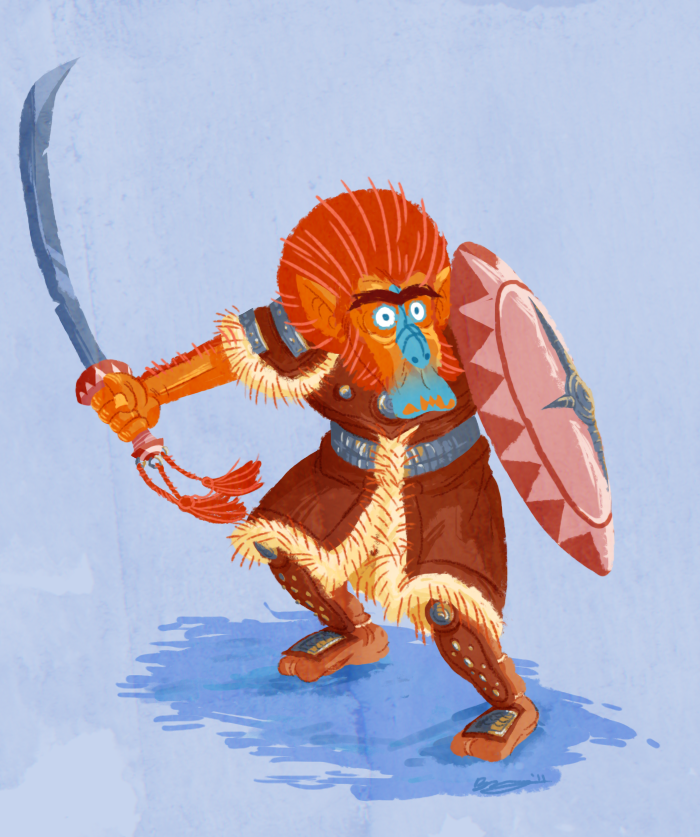
The Asherati are a race of elfish creatures who live in societies beneath the sands of great deserts. Standing around the height of the average human they nevertheless appear strangely lithe in their gait, wearing fluid, skin-hugging outfits of tanned leather. Their minimal taste in armour is a result of their primary method of travel - they are capable of swimming easily through sand, or other very loose soil, to get from place to place.

I went for a sort of earth-themed-Zora look for this guy, as you can probably see by the nose and the eyes. Did you ever play Majora's Mask? The Zora swimming sections in that are incredibly fun, they got a great feel for the momentum of it. Maybe it's an unconscious coincidence but the chunky golden swords remind me of the big weapons Ganon has in OoT.

This one's a back-and-forth mix of Photoshop and Paint Tool Sai.

- Joe

Monday, 25 March 2013

Carcass Eater


The Carcass Eater is a small animal a rat and a hound. As an animal whose main diet is comprised of carrion, its common haunts are graveyards, battlegrounds, abbatoirs and any other sort of place that would be home to heaps of rotting flesh. The Carcass Eater has a sharp sense of smell and can detect the smallest drop of blood, the scent of which drives it into a shark-like feeding frenzy. Its jaws are especially big, useful for tearing hunks of meat and breaking bones.

This was a blind image, given to me by Joe. I was kinda panicky when he gave it to me when I saw that it was an animal type creature. Animals tend to be, well, actual real creatures that either exist or have existed in the past; creatures of little intelligence and no magical ability. Sometimes there's bigger than usual. I was worried that he'd given me an actual animal and was worried that I was going to represent a real creature in a way that didn't represent it in reality. Which may have been interesting, now that I think about it, like how giraffes were drawn when the description was "camel-like creature with leopard spots".

Sunday, 8 July 2012

Eyeball Beholderkin


Beholders are (except for some rare occasions) solitary creatures. They're solitary because they're vain and spiteful creatures. They believe that they, as an individual, represent absolute physical and intellectual perfection, and can't stand the presence of other hideous, horribly imperfect creatures. They especially loathe other beholders, since the presence of another of their species is an insult to themselves.

They also really really hate beholderkin. Beholderkin are mutanted versions of this first species. Not sure how they came about, so I'm going to say wizards is probably most likely.

Eyeball beholderkin are the least threatening and weakest of the bunch. Where an actual beholder in a 8-foot creature of hate sporting a mass of eyestalks capable of party-ending magic, the eyeball beholderkin is an 8-inch nothing menacing you with cantrips (and a level one spell). They get used as familiars by wizards. They're on the same level as cats, toads and weasels in that sense.

Tuesday, 5 June 2012

Myconid


Myconids are the mushroom-people. Something quite well suited for your Mario-themed D&D game I suppose. They live to about 24 years of age, getting larger and stronger with each passing year until the ruler of a circle of myconids is about 12 feet tall. They do a good many things via spores, the main three being communication (initating a telepathing link with someone), alarm and reproduction. Older myconids can use their spores to pacify and cause hallucinations --essentially drugging the target-- and to briefly reanimate dead bodies as vaguely fungoid puppets. Eventually the eldest mushroom-man is able to produce potions, which I like to think is actually some organically generated goo rather than something from a cauldron.

So I guess if you do want to use these guys for your Mario-themed D&D game, having an older myconid around can really give it more horrifying angle.

I like mushrooms. They're a delicious piece of not-plant. I also like how weird they look; there are some that you could look at and be astounded to find that they are, in fact, a mushroom. All of the myconids in this image take inspiration from different kinds of mushroom, varying in crazy looks and deliciousness.

Monday, 30 January 2012

Clockwork Mender


Required raw materials: gold, silver, copper, rhodium, earth, amber, glass, ichor (earth elemental), blood (bird), blood (hornet), blood (own).

Being a bit late with these. I was working on last week's one and hoping to get it out on time, but it looks like it's gonna require a little bit more time.

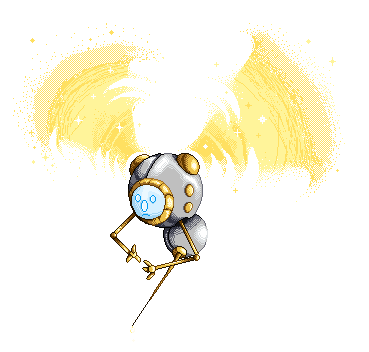
Clockwork Menders are cat-sized vaguely insectoid machines that exist to repair other constucts. They can be individuals, but are commonly found in swarms, though the swarm doesn't last very long as Clockwork Menders will use up their own life force in the repair of another construct. Their main form of defence is a numbing poison.

With the Improved Familiar feat, some ranks in Craft (blacksmithing) and an open-minded GM, you too can have one of these little creatures as a companion. That or you can try to steal one from the plane of Mechanus.

Trying out pixel-stuff a little bit, because its fun in a way. I'm not sure if I could do this consistently, but it's still fun.

I was actually originally trying to do this with pen and ink, but found that I'm still to inexperienced with it to have the steady hand required for perfect circles.

Thursday, 16 June 2011

Kenku

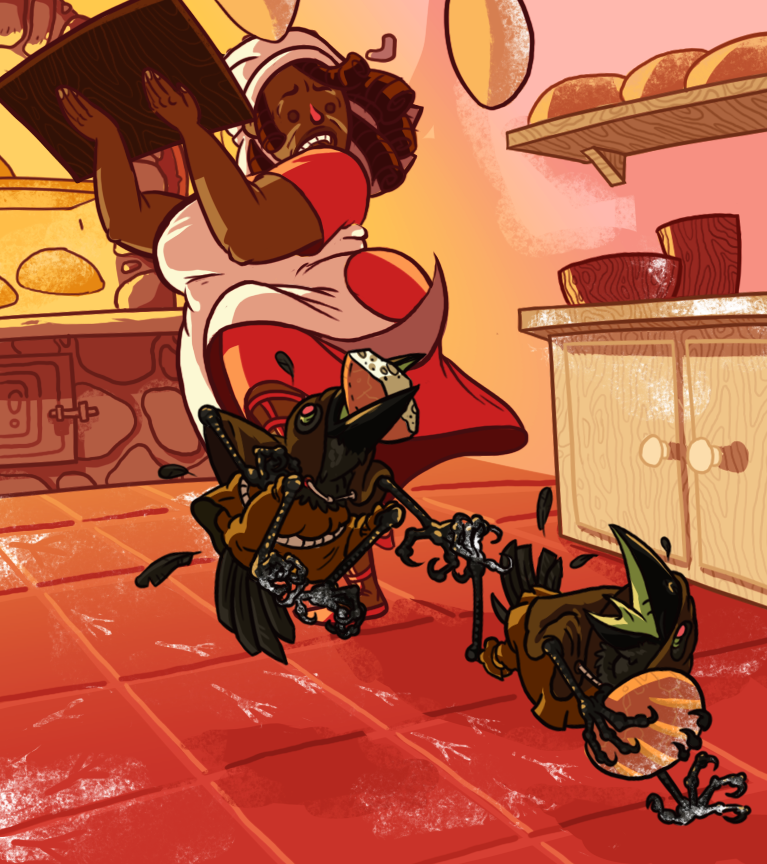
The Kenku are a race of flightless corvid humanoids that live in cities. They're of evil disposition and are especially prone to theft, which they execute in large groups. The Kenkus small size, ability to mimic sounds and strong sense of cooperation means they're often contracted as thieves, spies and assassins by those who'd rather not implicate themselves in that sort of crime.

I consider kenku in the same family as kobolds and goblins: absurd, cute, pathetic little creatures that are somehow supposed to imply a threat. They're a more dishonorable version of the tengu, a crow-man creature of Japanese mythology known for their mastery of the sword. The Oriental Adventures book has the more faithful version of the monster.

The winner of the poll was city monsters.I'm really late this week because I keep working on the goblin stuff instead. I finished modelling the character itself and all his clothing and have started working on the skeleton. I've also bee working on the blend shapes for his head, which is really fun. I'm going to have to figure out how to stop the teeth from popping out of the cheeks when the face morphs.


Edit: Improved the image some with colours, shading and floury footprints.

Sunday, 30 January 2011

Hobgoblin


The hobgoblins form the warrior branch of the goblin army, brandishing spears, axes and swords proudly looted from their fallen enemies. They are a fierce race, all trained in warfare and all eager to expand the empire of their species, but they are as likely to attack another tribe of their own kind as to attack others.

The hobgoblins are the larger cousins of the goblins, man-sized and relying more on tactics and strength than on sneakiness. Though barbaric, they're extremely loyal to their chiefs. They're also another typical low-level encounter.

Sorry about the no entries last week. We wanted to open the post-Guest Week with some animations, but we proved to be a little ambitious. The animations will still be posted in the future, but they still need some work.

Meanwhile, enjoy a mandrill with a sword.